
The New Recruitment Challenge: Identifying the Right Candidates
Recruitment has evolved. With candidates available across multiple platforms, the challenge is no longer simply finding talent. It is identifying the right people, validating their capabilities and matching them to the right opportunities. Discover how AI-powered candidate intelligence is changing recruitment.
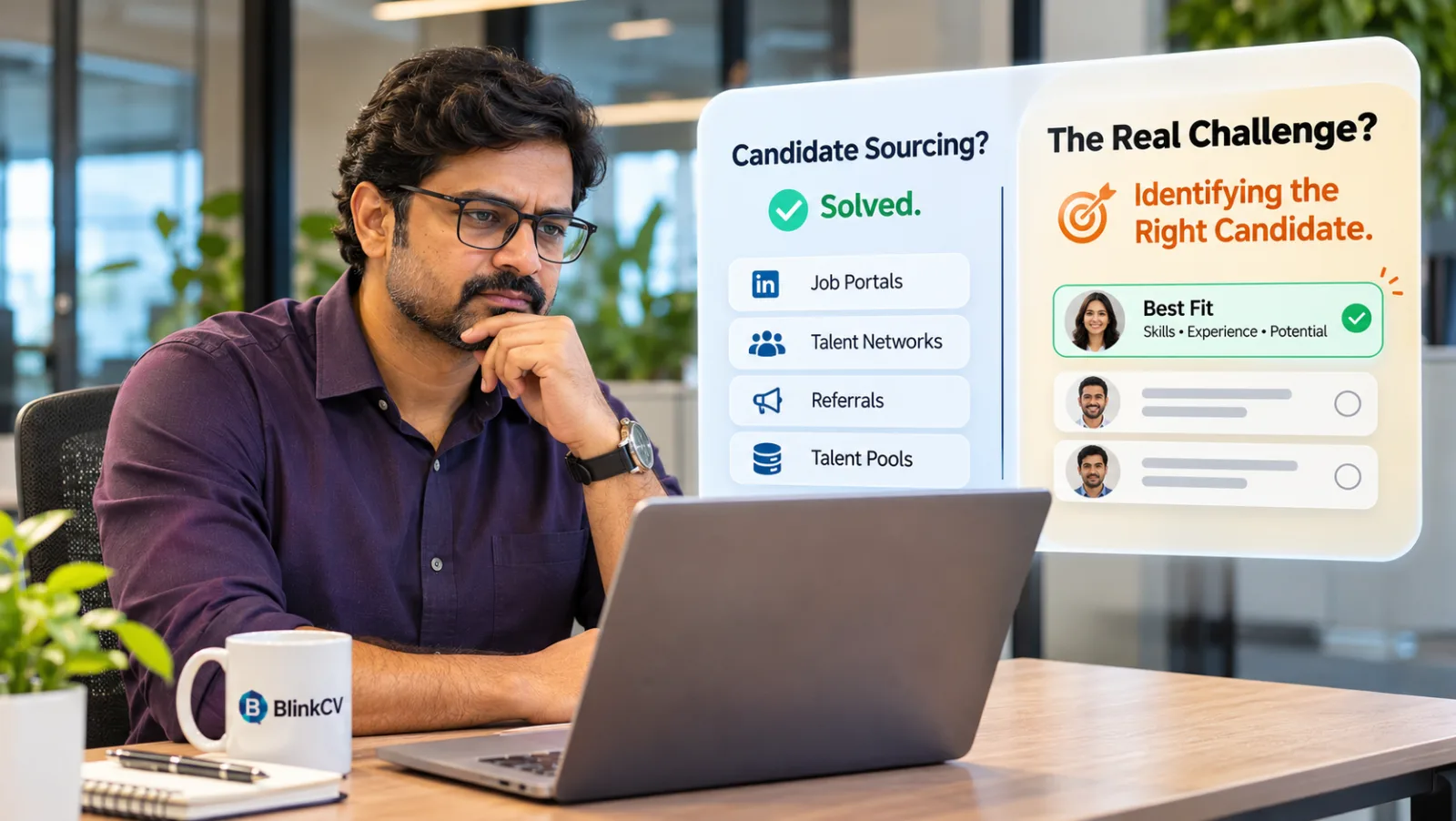
Recruiters invested significant time and resources in job portals, recruitment agencies, professional networks, referrals, campus hiring and talent databases to attract potential applicants.
But the recruitment landscape has changed.
Today, candidates are available across multiple platforms. Recruiters can access extensive talent databases, professional networks, job portals and growing communities of skilled professionals.
Artificial intelligence is also making it easier to discover profiles, search candidate databases and automate parts of the sourcing process.
Yet, despite having access to more candidates than ever, recruiters continue to face a familiar problem:
How do you identify the right candidate from hundreds or even thousands of available profiles?
The challenge is gradually shifting from candidate sourcing to candidate identification.
Finding people is one thing. Understanding their actual capabilities, evaluating their suitability and identifying the best match for a specific position is another.
This distinction could become one of the most important developments in modern talent acquisition.
1. The Candidate Pool Is Growing, but So Is the Complexity
Recruitment has become increasingly digital.
A single job vacancy can attract applications through several channels:
LinkedIn and other professional networks.
Online job portals.
Company career websites.
Recruitment agencies.
Employee referrals.
Campus placement programmes.
Professional communities and talent databases.
For popular positions, recruiters may receive hundreds of applications.
At first glance, this appears to be a sourcing success. However, a larger candidate pool does not automatically result in better hiring outcomes.
In fact, it can create additional challenges.
Recruiters must review more profiles, identify relevant experience, validate skills, compare candidates and shortlist people who genuinely meet the requirements of the position.
The problem is no longer just attracting applications.
It is making sense of the information contained within them.
2. A Resume Does Not Always Reveal a Candidate's True Potential
The traditional resume remains an important recruitment document. It provides a summary of a candidate's education, employment history, skills, certifications and achievements.
However, it has limitations.
Two candidates may have similar job titles, qualifications and years of experience, but their actual capabilities could be very different.
Consider a simple example.
Two candidates apply for a Cloud Security Engineer position.
Candidate A:
Five years of IT experience.
AWS and Azure listed as technical skills.
Experience working in infrastructure support.
Limited exposure to security architecture.
Candidate B:
Three years of relevant experience.
Practical cloud security implementation.
Experience with IAM, cloud configuration reviews and security monitoring.
Demonstrated involvement in security improvement projects.
A basic resume comparison might prioritize Candidate A because of the longer experience duration.
However, when the actual requirements of the position are considered, Candidate B may demonstrate stronger relevant evidence.
This is why recruiters need to look beyond job titles, keywords and years of experience.
The objective should be to understand what candidates can actually do and how their capabilities align with the role.
3. More Applications Do Not Necessarily Mean Better Candidates
One of the biggest misconceptions in recruitment is that a larger number of applications automatically improves hiring outcomes.
Imagine a company receives 1,000 applications for a software development position.
The recruitment team now has to:
Review 1,000 resumes.
Identify relevant technical skills.
Understand employment and project experience.
Filter candidates against job requirements.
Compare qualifications and practical exposure.
Shortlist candidates for further evaluation.
Even with an Applicant Tracking System (ATS), the quality of the information available and the effectiveness of the evaluation process remain important.
A large volume of applications can increase screening effort without necessarily improving the quality of the shortlist.
Recruiters need better ways to distinguish between candidates who simply match keywords and candidates who demonstrate relevant capabilities.
The real objective is not to process more applications. It is to identify the most relevant talent efficiently and consistently.
4. The Shift from Keyword Matching to Evidence-Based Candidate Evaluation
Traditional resume screening often starts with keywords.
A recruiter searches for skills such as Python, Java, AWS, cybersecurity, project management or financial analysis.
This approach is useful for discovering potentially relevant profiles, but keywords alone cannot establish proficiency.
For example, mentioning Python on a resume does not explain whether a candidate has:
Built production applications.
Worked with data processing frameworks.
Developed automation scripts.
Solved real-world technical problems.
Contributed to collaborative development projects.
Similarly, listing project management experience does not reveal the complexity of projects delivered, budgets managed or business outcomes achieved.
Recruitment needs to move towards evidence-based candidate evaluation.
This means examining:
Relevant project experience.
Practical application of skills.
Individual responsibilities and contributions.
Measurable achievements.
Certifications and qualifications.
Problem-solving capabilities.
Evidence of role-specific competencies.
Evidence-based evaluation provides a more meaningful foundation for understanding candidates than relying exclusively on resume keywords.
5. Candidate Identification Requires More Than an ATS
Applicant Tracking Systems have become an important part of modern recruitment.
They help organizations manage job applications, maintain candidate records, coordinate hiring workflows and support recruiter searches.
However, managing applications and identifying the most suitable candidates are related but different activities.
An ATS helps recruiters organize the recruitment process.
Candidate intelligence can help recruiters understand the people within that process.
Consider the difference:
Traditional recruitment approachCandidate intelligence approachSearch using resume keywordsAssess relevant skills and supporting evidenceFilter by years of experienceExamine relevant experience and responsibilitiesReview individual resumesBuild structured candidate profilesManually compare applicantsSupport structured candidate comparisonsFocus on current vacanciesOrganize talent for future opportunitiesDepend heavily on manual screeningUse AI-assisted evaluation to support recruiter reviewThese approaches are complementary. An ATS remains valuable for managing recruitment workflows, while additional intelligence can help recruiters make more informed candidate assessments.
6. AI Is Changing How Recruiters Identify Talent
Artificial intelligence introduces new possibilities for candidate identification.
Instead of relying entirely on manual resume reviews, AI-assisted recruitment platforms can help organize candidate information, identify relevant skills and support comparisons against job requirements.
Depending on the platform and implementation, these capabilities may include:
Intelligent candidate matching
Identify candidates whose skills and experience appear relevant to a specific job description.
Skills identification
Extract and organize information about technical and professional capabilities from candidate profiles.
Candidate intelligence scoring
Generate structured indicators of how closely a candidate's available information aligns with defined job requirements.
Candidate comparison
Help recruiters compare multiple applicants against consistent evaluation criteria.
Talent rediscovery
Identify previously reviewed candidates who may be relevant to new job openings, subject to applicable data permissions and retention policies.
AI-assisted evaluation
Help recruiters organize information and prioritize profiles for further review.
However, AI-generated scores and recommendations should never be treated as unquestionable measures of a candidate's ability.
Recruiters must be able to review the underlying evidence, understand limitations, assess fairness and retain meaningful human oversight.
The value of AI is in helping recruiters make better-informed decisions, not making hiring decisions without accountability.
7. Candidate Experience Also Needs to Become More Meaningful
Candidate identification is not only about helping employers.
It is also about giving candidates better opportunities to communicate their capabilities.
Many skilled professionals struggle to differentiate themselves in a crowded job market.
Fresh graduates may have strong academic projects but limited employment history. Experienced professionals may have valuable achievements that are not immediately obvious from their resumes.
Candidates need ways to communicate more than their job titles and educational qualifications.
This is where richer professional profiles, practical skill evidence and Career Snapshots can add value.
A candidate should have the opportunity to communicate:
Who they are professionally.
What they are capable of doing.
What projects and achievements demonstrate their skills.
What career opportunities they are pursuing.
What makes their experience relevant.
Better candidate information can support more meaningful recruiter conversations and improve the overall evaluation process.
8. Talent Pools and Rediscovery: The Opportunity Beyond Today's Vacancy
Recruitment teams often concentrate on candidates applying for current vacancies.
But what happens to strong candidates who were not selected?
A candidate may not be suitable for one position but could be an excellent match for another opportunity.
For example, a candidate applying for a Senior Software Engineer position may also be suitable for an Application Security Engineer role, depending on their skills and experience.
Organizations can benefit from maintaining structured talent pools that allow relevant candidates to be rediscovered when new requirements arise.
This can help recruiters:
Revisit previously evaluated candidates.
Identify transferable skills.
Reduce repeated sourcing effort.
Build specialist talent communities.
Improve continuity across recruitment campaigns.
Candidate rediscovery must, of course, respect consent, privacy obligations and appropriate data-retention policies.
The broader opportunity is to make better use of talent organizations have already encountered.
9. What Recruitment Teams Should Start Measuring
If candidate identification is becoming a strategic priority, recruitment teams should look beyond the number of applications received or resumes processed.
Consider tracking these measures:
MetricWhat it indicatesQualified candidate ratioPercentage of applicants meeting defined job criteriaShortlist conversion ratePercentage of reviewed candidates progressing to the shortlistInterview-to-offer ratioEffectiveness of candidate evaluation and selectionTime to shortlistTime required to identify suitable candidatesCandidate rediscovery rateValue generated from existing talent poolsHiring manager satisfactionPerceived relevance and quality of shortlisted candidatesQuality of hireLonger-term outcomes of recruitment decisionsThese measures help organizations understand whether their recruitment processes are identifying relevant talent rather than simply processing applications.
How BlinkCV Is Approaching the Candidate Identification Challenge
At BlinkCV, we believe modern recruitment needs to move beyond traditional resume-centric screening.
The objective is not simply to help recruiters find more candidates. It is to help them understand candidates better and identify relevant talent more effectively.
BlinkCV brings together candidate Career Snapshots and AI-powered recruiter capabilities to support this approach.
Key capabilities include:
1. Career Snapshots
Give candidates another way to communicate their professional identity, strengths, experience and career direction beyond a traditional resume.
2. Candidate Intelligence Score
An AI-assisted score out of 10 helps recruiters assess candidate alignment with job requirements and prioritize profiles for further review.
3. Evidence-Backed Skills Profiles
Provide a more structured view of candidate skills and supporting information rather than depending exclusively on resume keywords.
4. Candidate Comparison
Help recruiters compare applicants against relevant job requirements and understand differences in their profiles.
5. Talent Pools and Rediscovery
Support the organization and rediscovery of candidate profiles for future recruitment opportunities.
6. AI-Assisted Candidate Evaluation
Support recruiter workflows through structured candidate intelligence while retaining human judgement and accountability.
Together, these capabilities aim to help recruiters move from simply managing applications towards a more informed candidate evaluation process.
Final Thoughts: Recruitment's Next Competitive Advantage Is Better Candidate Identification
The recruitment industry has spent years improving its ability to attract and source candidates.
Digital job portals, professional networks, recruitment platforms and AI-assisted sourcing tools have expanded access to talent.
But access to more profiles does not automatically mean access to better hiring decisions.
The next challenge is understanding who the candidates really are, what they can contribute and how closely their capabilities align with organizational requirements.
Recruitment teams that combine relevant candidate information, evidence-based evaluation, structured comparisons and responsible AI assistance can build a more informed hiring process.
The future of recruitment will not be determined by who can find the most resumes. It will increasingly depend on who can identify the right talent.
Move Beyond Traditional Resume Screening with BlinkCV
Are you looking to improve how your recruitment team evaluates and compares candidates?
Discover BlinkCV Recruiter's AI-powered candidate intelligence, evidence-backed skills profiles and candidate evaluation capabilities.
Explore BlinkCV at https://blinkcv.ai and discover a smarter approach to understanding talent.