Beyond the CV: Giving Qualified Candidates a Chance to Be Seen
Talented candidates are often overlooked in a crowded recruitment market, not because they lack skills, but because their capabilities remain hidden behind traditional resumes. Discover why candidates need better visibility and how AI-powered Career Snapshots can help connect talent with opportunities.
Both have relevant qualifications. Both possess the required technical skills. Both have worked on meaningful projects and have the potential to perform well.
But one candidate's CV catches the recruiter's attention, while the other's application disappears among hundreds of submissions.
Does that necessarily mean the first candidate is better?
Not always.
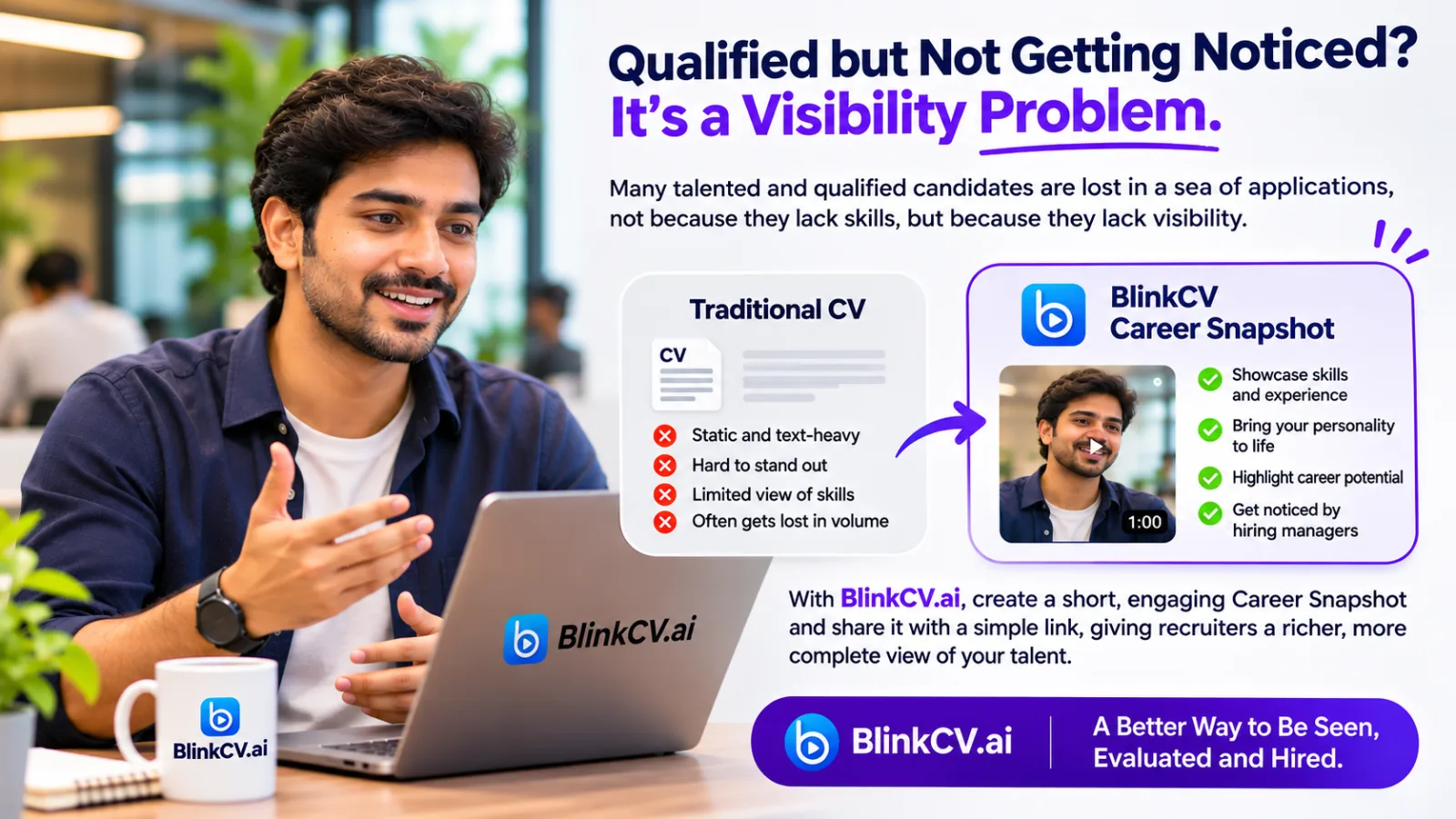
This highlights a major gap in today's recruitment process: qualified candidates are often lost in a sea of applications, not because they lack the skills, but because they lack visibility.
As organizations receive applications through job portals, professional networks, recruitment agencies and company career websites, recruiters face an increasingly difficult task: identifying the right people from a growing pool of applicants.
The result?
Talented individuals can remain unnoticed, while recruiters spend considerable time reviewing documents that do not always reveal the complete potential of a candidate.
Perhaps it is time to rethink how we introduce talent to employers.
1. The Visibility Gap: When Good Candidates Go Unnoticed
A traditional CV is designed to communicate professional information in a structured format.
It typically includes:
Educational qualifications.
Employment history.
Technical and professional skills.
Certifications.
Projects and achievements.
Contact information.
These details are important. But they do not always communicate everything that makes someone a valuable candidate.
Consider a fresh graduate who has completed an impressive academic project, developed practical technical skills and possesses excellent communication abilities.
Their CV may be limited to one page, with little room to demonstrate their actual capabilities.
Similarly, an experienced professional may have managed complex projects, led teams and delivered significant business outcomes, but those achievements may be buried within several pages of employment history.
In both situations, the problem may not be a lack of capability.
The problem is that the candidate's value is not immediately visible.
A recruitment process that depends too heavily on scanning documents risks overlooking people who deserve further consideration.
2. The Challenge Is Not Always Finding Candidates. It Is Understanding Them.
Recruiters today have access to more candidate discovery channels than ever before.
They can search through:
LinkedIn and professional networks.
Online job portals.
Applicant Tracking Systems.
Recruitment agency databases.
Employee referral programmes.
Professional communities and talent pools.
Yet, access to more candidate profiles does not automatically translate into better hiring decisions.
Recruiters still need to understand:
What can this candidate actually do?
How relevant is their experience to the position?
What projects have they delivered?
How effectively can they communicate?
What makes them different from other applicants?
Do they have the potential to grow into the role?
A CV provides some of these answers, but often not all of them.
The next evolution of recruitment should focus not just on collecting candidate information, but on making relevant candidate capabilities easier to discover and understand.
3. A CV Tells Your Professional History. It Doesn't Always Tell Your Story.
Think about how people introduce themselves during an interview.
When someone asks, "Tell me about yourself", candidates get an opportunity to explain their experience, strengths, achievements and ambitions.
They can communicate their professional identity in their own words.
But before an interview happens, recruiters often see only a document.
What if candidates had another way to introduce themselves before reaching the interview stage?
Imagine being able to communicate:
Who you are: Your professional identity, education and career background.
What you know: Your technical capabilities, professional skills and areas of expertise.
What you have done: Your projects, achievements and practical experience.
What makes you different: Your strengths, communication and individual professional perspective.
Where you are heading: Your career aspirations and the opportunities you are pursuing.
This additional context can help candidates present a more complete professional picture.
It does not replace a traditional CV. It complements it.
4. Why Candidates Need More Than Just Another Resume Template
The internet already offers countless resume templates, CV builders and formatting tools.
But the real challenge for many job seekers is not simply creating another document.
It is communicating their professional identity effectively.
A better candidate experience should help individuals present their capabilities in a way that is:
Easy to understand.
Quick to access.
Simple to share.
Relevant to recruiters.
More engaging than a list of qualifications alone.
For fresh graduates, this can provide an opportunity to introduce academic projects, practical skills and career aspirations.
For experienced professionals, it can help communicate specialization, leadership experience, achievements and professional direction.
For career changers, it can help explain transferable skills and demonstrate why their previous experience is relevant to a new opportunity.
Candidates deserve an opportunity to demonstrate their potential, not just submit another document and wait.
5. Introducing the Career Snapshot: A Different Way to Present Yourself
This is where the idea of a Career Snapshot becomes relevant.
A Career Snapshot provides candidates with a concise, engaging way to introduce their professional identity and share it through a simple link.
Instead of relying entirely on a traditional CV, candidates get another opportunity to communicate their background, skills, experience and career direction.
Imagine a recruiter receiving a candidate's profile and being able to explore a concise professional introduction before deciding on the next step.
The candidate has an opportunity to communicate more context, while the recruiter has another source of information to support the evaluation process.
A Career Snapshot can be particularly useful for:
Fresh graduates: Introduce education, projects, technical skills and career ambitions.
Experienced professionals: Highlight expertise, achievements, leadership and specialization.
Technical professionals: Communicate areas of technical capability and relevant project experience.
Career changers: Explain transferable skills and professional direction.
Active job seekers: Share a consistent professional introduction with recruiters and hiring managers.
The objective is simple: help people communicate more effectively and give their professional profiles greater visibility.
6. Why Recruiters and Hiring Managers Benefit Too
This is not just about giving candidates another way to present themselves.
Recruiters and hiring managers also benefit from having richer candidate information available.
When evaluating applicants, they need to understand more than job titles and keywords.
A well-presented candidate profile can provide additional context about:
Professional background.
Relevant skills.
Project experience.
Career interests.
Individual achievements.
Professional presentation.
Combined with appropriate candidate assessment tools, this can support more informed recruitment conversations.
AI-powered recruitment platforms can take this further by helping recruiters organize candidate information, identify job-related skills and compare applicants against defined requirements.
However, candidate profiles and AI-generated scores should support—not replace—human judgement.
The hiring decision should remain grounded in relevant evidence, fairness and the actual requirements of the position.
7. AI Should Make Talent More Visible, Not Make Recruitment More Impersonal
Artificial intelligence is changing how organizations discover and evaluate candidates.
AI-assisted recruitment capabilities can help with:
Organizing candidate information.
Identifying relevant skills.
Supporting job-to-candidate matching.
Comparing candidate profiles.
Highlighting relevant experience.
Rediscovering previously reviewed talent.
But there is an important distinction between using AI to filter more candidates and using AI to understand candidates better.
The objective should not be to reduce every individual to a number or automatically eliminate people based on an algorithm.
A candidate's experience, personality, communication, practical capabilities and potential deserve meaningful consideration.
AI should help recruiters find relevant information faster, while human professionals remain responsible for evaluating context and making hiring decisions.
Technology should improve the visibility of talent, not create another barrier between candidates and opportunities.
8. Why We Built BlinkCV.ai
We started BlinkCV with a simple observation:
There are talented people who deserve better opportunities, but their capabilities are not always visible through traditional recruitment processes.
A candidate may have excellent skills but struggle to communicate them through a conventional CV.
A fresh graduate may have meaningful projects but limited professional experience.
An experienced professional may have delivered significant achievements that are difficult to communicate in a few pages.
We believe these candidates deserve another way to introduce themselves.
That's exactly why we built BlinkCV.ai — an AI-powered career platform where candidates can create a short, engaging Career Snapshot and share it through a simple link.
Our vision is to make professional introductions more accessible, engaging and useful for both candidates and recruiters.
What BlinkCV brings to the candidate experience
1. Career Snapshot
Create a concise professional introduction that communicates your background, skills, experience and career aspirations.
2. Simple Sharing
Share your Career Snapshot through a convenient link with recruiters, hiring managers and professional contacts.
3. ATS Resume Check
Compare your CV with a specific job description and understand areas where your profile could be better aligned.
4. Better Professional Visibility
Give recruiters another way to discover and understand your professional profile beyond traditional resume screening.
What BlinkCV brings to recruiters
Through BlinkCV Recruiter, we are also building capabilities to help recruitment teams move beyond conventional resume-centric screening.
These include:
Candidate Intelligence Score.
Evidence-Backed Skills Profiles.
Candidate Comparison.
Talent Pools and Rediscovery.
AI-Assisted Candidate Evaluation.
Together, these capabilities aim to support a more informed approach to candidate identification and evaluation.
9. The Future of Recruitment Should Give Every Qualified Candidate a Better Opportunity
Recruitment should not simply be about how many resumes an organization receives or how quickly an ATS processes applications.
It should be about understanding people, identifying relevant capabilities and connecting the right talent with the right opportunities.
A candidate should not become invisible simply because their CV could not communicate their full potential.
Employers need better ways to understand talent.
Recruiters need better tools to identify relevant candidates.
And job seekers need better opportunities to present themselves.
The future of recruitment should bring these three needs together.
The future of recruitment should be about discovering the right talent, not just filtering resumes.
It's time to give qualified candidates a better chance to be seen and heard.
Give Your Career a Better Introduction with BlinkCV
Are you a fresh graduate looking for your first opportunity? An experienced professional exploring your next career move? Or someone who wants to communicate their skills and professional identity more effectively?
Don't let your professional story remain hidden inside a traditional CV.
Create your Career Snapshot with BlinkCV and share your professional identity through a simple link.
Explore BlinkCV: https://blinkcv.ai
Your talent deserves to be seen. Your experience deserves to be understood. Your next opportunity deserves a better introduction.